
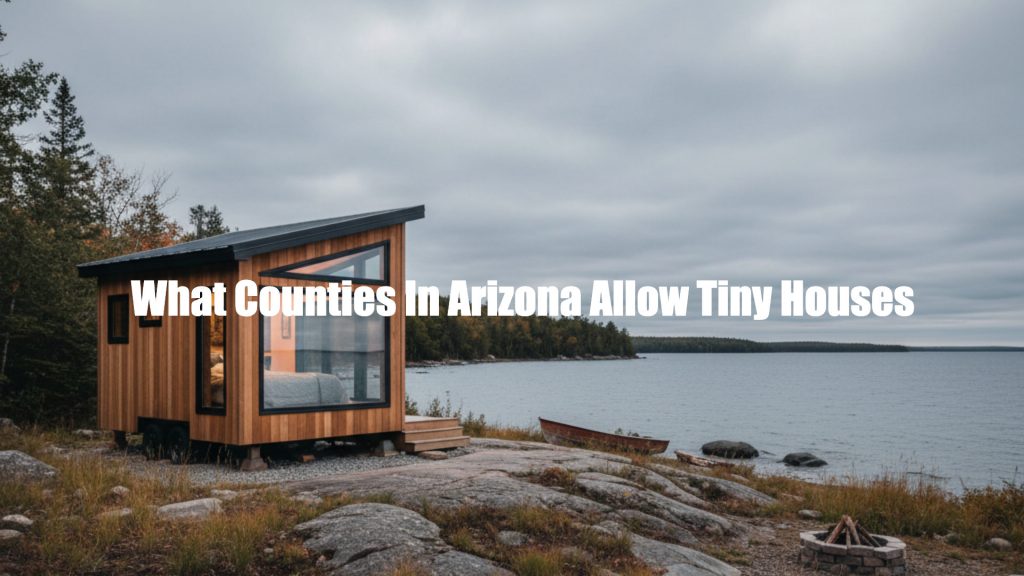
Arizona permits tiny houses in numerous counties, with Pima County and Coconino County leading as the most accommodating, allowing structures under 400 square feet on permanent foundations within single-family residential zones. Tiny houses on wheels are classified as RVs and require building permits, authorized trailers, and a minimum of 160 square feet, though permanent residency restrictions apply in many areas. Regulations vary by county and city, emphasizing compliance with the International Residential Code Appendix Q for safety and habitability.
The tiny house movement continues to gain momentum in Arizona, fueled by the state’s desirable climate, breathtaking natural landscapes, and growing demand for affordable, eco-conscious housing alternatives. As affordability issues in traditional housing persist, more individuals and families are turning to compact living to achieve greater financial freedom and minimize their environmental footprint. This refreshed guide offers an up-to-date examination of tiny house regulations throughout Arizona’s counties and municipalities, equipping potential builders and buyers with essential knowledge on zoning, building codes, and permitting procedures.
Arizona’s varied terrain—from the arid southern deserts to the pine-covered northern highlands—presents diverse possibilities for tiny home sites, whether on expansive rural parcels or in organized communities. Grasping these local differences is vital, as certain regions actively promote alternative housing while others uphold more conservative standards. Great Lakes Tiny Homes, a premier manufacturer of modular, park model, and tiny homes, provides complete solutions with nationwide delivery to all 48 contiguous U.S. states, including options with or without wheels and RVIA certification—commonly known as park models for certified units. To receive customized advice on aligning your project with these regulations, book a call with our experts.
Disclaimer: This article is for informational purposes only and does not constitute legal advice. Laws, regulations, and zoning rules vary by location and may change over time. Always consult your local zoning office or a qualified land use/zoning attorney before making decisions based on this information.
What Counties in Arizona Allow Tiny Houses?
Pima County and Coconino County remain Arizona’s foremost advocates for tiny-house-friendly policies, having implemented frameworks that support compact dwellings on permanent foundations. These counties appreciate the role of tiny homes in alleviating housing shortages and advancing sustainable growth. Additional regions, including Mohave and Cochise Counties, have introduced facilitating initiatives such as owner-builder programs and eased permitting in rural districts. Nevertheless, specifics can diverge markedly, underscoring the importance of confirmation with local officials to guarantee adherence.
Ongoing legislative initiatives, including House Bill 2096, seek to standardize permitting statewide by barring counties from mandating building permits for qualifying single-family homes and accessory dwelling units on conforming lots. This evolution highlights Arizona’s progressive attitude toward adaptable housing forms. Those eyeing available opportunities might explore tiny houses for sale in Arizona that satisfy these standards.

Pima County
Pima County’s guidelines authorize tiny homes of varying sizes on permanent foundations within single-family residential zones, consistent with the 2018 International Residential Code (IRC) Appendix Q for building and inspection criteria. This innovative policy accommodates both off-site prefabrication and on-site construction, streamlining certification for owners. Tiny houses on wheels encounter more rigorous zoning, typically confined to RV parks or short-term applications. The Pima County Permitting Regulation for Tiny Houses delivers a thorough outline of these provisions.
Compliance involves addressing setbacks, utilities, and ecological factors to obtain a certificate of occupancy. Such policies have spurred the development of tiny home enclaves around Tucson, attracting a mix of retirees, young professionals, and eco-enthusiasts seeking simplified lifestyles.
Coconino County
Coconino County, home to locales like Flagstaff and Sedona, enforces targeted zoning and building codes for tiny houses, encompassing minimum lot dimensions, setbacks, and foundation stipulations. Tiny houses on wheels may incorporate graywater systems yet demand fixed positioning for optimal operation, with inspections verifying environmental suitability. The county’s approval mechanism endorses both permanent and transitional builds, nurturing environmentally sound projects in its wooded expanses. Consult the Coconino County Permitting Regulations for Tiny Houses for exact directives.
These stipulations harmonize the safeguarding of scenic environments with housing creativity, permitting tiny homes in residential districts while barring them from elevated fire-hazard zones absent proper safeguards. Municipal codes encourage sustainable elements like solar installations, resonating with Arizona’s emphasis on renewable energy adoption.
Mohave County
Mohave County categorizes tiny houses as structures of 600 square feet or smaller, allowing them in rural settings where building permits are frequently exempted beyond city limits such as Kingman or Bullhead City. This leniency draws off-grid advocates to the county’s expansive desert landscapes. Builds must align with the county’s building ordinance, prioritizing resilience in earthquake- and wind-vulnerable regions. The Mohave County Building Ordinance 2021-03 establishes the definitive structure.
Emerging proposals continue to relax stipulations for tiny house proponents, concentrating on owner-constructed variants without sacrificing code integrity. This strategy bolsters economic vitality in isolated locales while upholding livability benchmarks.
County-by-County Breakdown: Where Tiny Houses Are Allowed
| County/City | Min. Sq Ft | Zoning Allowed | Key Requirements | Source | Verified |
| Pima County | No minimum | Single-family residential | Permanent foundation required; 2018 IRC Appendix Q | Pima County Permitting Regulation for Tiny Houses | Yes |
| Coconino County | 160 sq ft (THOW) | Residential zones | Specific setbacks, foundation requirements; graywater systems for THOW | Coconino County Permitting Regulations for Tiny Houses | Yes |
| Mohave County | 600 sq ft max | Rural areas | Building permits often waived outside cities; comply with county ordinance | Mohave County Building Ordinance 2021-03 | Yes |
| Cochise County | 400 sq ft | Owner-builder program zones | Appendix Q compliance, inspections; permitted where single-family dwellings allowed | Cochise County Tiny Homes Guidelines | Yes |
| Maricopa County | Varies by city (e.g., 200 sq ft ADU) | ADU zones | Local municipality approval; up to 75% of main house floor area in Phoenix | Phoenix ADU Regulations | Yes |
| Yavapai County | 400 sq ft | Rural residential | Building codes compliance; small site-built homes allowed with permits | Yavapai County Planning FAQ | Yes |
| Pinal County | Varies (manufactured min 400 sq ft) | Residential with permits | Permits required for manufactured homes including park models; zoning compliance | Pinal County Manufactured Home FAQ | Yes |
| Yuma County | No specific min; general building codes | Residential zones | Building permits required for construction; comply with structural, plumbing standards | Yuma County Building Safety FAQ | Yes |
Disclaimer: Regulations are subject to change; verify with local authorities for the most current information.
Tiny House Rules And Regulations In Arizona
In Arizona, tiny houses are typically defined as residential units under 400 square feet, while tiny houses on wheels (THOWs) qualify as mobile dwellings needing at least 160 square feet pursuant to Appendix Q of the International Residential Code. The state’s zoning framework is comparatively accommodating, permitting tiny homes in accessory dwelling unit (ADU), detached single-family, and multifamily districts, albeit with local nuances. Arizona’s statewide embrace of Appendix Q promotes uniform construction practices, highlighting safety aspects such as emergency egress and adequate airflow. House Bill 2096 additionally simplifies permitting for select structures, enhancing housing accessibility. The Arizona House Bill 2096 Summary elaborates on these elements.
Adherence to plumbing, electrical, and structural standards is obligatory, frequently necessitating expert inspections to affirm suitability for Arizona’s intense weather patterns. These guidelines bolster the tiny home trend by integrating innovation with community welfare, especially in regions susceptible to wildfires or flooding.
Permanent Structure Rules
Permanent tiny homes in Arizona demand sturdy foundations, enhanced underfloor insulation, and compliance with overall ceiling heights of at least 6’4″, alongside electrical panels of no less than 60 amperes. These dwellings must include one designated bedroom featuring an emergency exit and satisfy ventilation and plumbing norms to manage desert temperatures effectively. Loft spaces in permanent constructions require a minimum of 35 square feet, with dimensions ensuring 3 feet of vertical clearance and 5 feet of horizontal span for practical use. Arizona’s diverse topography, spanning the Grand Canyon to the Colorado River, shapes location-based mandates like seismic fortification.
Constructing permanent tiny homes yields permanence and qualification for real estate tax evaluations, distinguishing them from mobile counterparts. Proprietors are advised to reference local codes for incorporating energy-saving technologies, such as passive solar design, which receive growing state incentives.
Temporary Structure Rules
Temporary tiny houses on wheels call for a construction permit and a licensed trailer, succeeded by inspections prior to habitation. Measuring at least 160 square feet, THOWs may be stationed on sanctioned foundations like mobile home piers, though the state regards them as impermanent if registered as travel units. Arizona’s plentiful state parks facilitate parking in RV zones, affording versatile arrangements for itinerant dwellers. Yet, extended stays in THOWs are curtailed beyond approved parks.
These provisions safeguard portability alongside addressing hazards like towing security and climate durability. For THOW-supportive enclaves, review insights on the best tiny home communities in Arizona.
Transitional Structure Rules
Transitional tiny houses, frequently skid-based, must eliminate transport elements like wheels for permanent installation to conform to building codes akin to those for fixed structures. Skids enable occasional relocation via trailer, albeit at considerable expense and effort. Arizona statutes mandate IRC conformity for these hybrid forms, encompassing utility linkages and occupancy validations. They serve as intermediaries between mobile and stationary housing, fitting for incremental projects.
Transitional variants offer advantages in shifting regulatory contexts, though conversion expenses warrant forethought. This type suits exploratory constructions in northern Arizona’s rural counties.
In Arizona Where Can I Build A Tiny House?
Tiny houses in Arizona may be erected in multifamily housing districts, standalone single-family locales, and accessory dwelling unit areas, contingent on securing local endorsements. THOWs are confined to mobile home or RV facilities, with the state’s abundant state parks providing periodic parking venues. Unincorporated rural expanses afford maximal adaptability, notably in counties like Mohave for disconnected configurations. Metropolitan zones might restrict sites to rear yards as ADUs, governed by setback guidelines.
Site evaluation entails evaluating utilities, flood vulnerabilities, and service proximity, with solar energy prevalent in isolated builds. For builder suggestions in targeted locales, peruse tiny house builders in Arizona.
Major Arizona Cities: Tiny House Requirements
Phoenix (Maricopa County)
Phoenix requires alignment with conventional residential codes for tiny houses, disallowing THOWs as enduring residences but endorsing foundation-based units as ADUs in specified zones. As many as two ADUs per parcel are feasible, each capped at 75% of the principal home’s area, with five-foot side and rear setbacks. The municipality’s strategies advance affordable housing efforts, featuring expedited approvals for conforming constructions. Connect with the Phoenix Planning and Development Department at (602) 262-7811 for details. Phoenix Accessory Dwelling Units Guidelines.
These measures foster infill growth in city neighborhoods, mitigating Phoenix’s expansion strains while upholding visual coherence.
Tucson (Pima County)
Tucson mirrors Pima County’s progressive outlook, sanctioning tiny homes of diverse sizes on permanent foundations in single-family zones to tackle housing costs. The city nurtures the tiny house initiative via workshops and code clarifications favoring concise layouts. ADUs necessitate IRC Appendix Q observance, stressing water efficiency in the parched setting. Reach Tucson Planning and Development Services at (520) 837-4956. Disclaimer: Verify current ordinances with city officials.
Regional rebates for eco-friendly construction amplify Tucson’s allure for sustainable tiny dwellings.
Mesa (Maricopa County)
Mesa’s ADU bylaws support foundation tiny houses, demanding IRC conformity and civic sanction, whereas THOWs prove inadequate for lasting occupancy. Edifices must observe elevation caps and utility benchmarks, with approvals encompassing site blueprints and examinations. The city emphasizes family-oriented zoning, restricting ADUs to supplementary roles. Contact Mesa Planning Division at (480) 644-2388.
Such regulations equilibrate suburban identity with housing variety, especially in burgeoning neighborhoods.
Flagstaff (Coconino County)
Flagstaff has integrated Appendix Q, facilitating tiny houses under county protocols and sustaining specialized communities. Permanent edifices necessitate foundations and ecological assessments given the region’s altitude and fire perils. THOWs remain limited to RV sectors. Contact Flagstaff Planning and Zoning at (928) 213-2600.
The municipality’s sustainability emphasis incorporates incentives for energy-thrifty tiny homes.
Chandler (Maricopa County)
Chandler authorizes tiny homes as ADUs on single-family parcels, with size floors fluctuating per bylaws but typically matching state norms at 200 square feet or above. Permanent foundations are imperative, and builds must harmonize with local aesthetics. Approvals entail blueprint evaluations for utilities and offsets. Contact Chandler Planning Division at (480) 782-3000. Disclaimer: Local rules may evolve; consult professionals.
This methodology accommodates Chandler’s swift expansion while conserving communal norms.
Tiny Home Communities in Arizona
Tiny home communities across Arizona are proliferating, furnishing certified parcels and occupancy endorsements that sync with statewide inclinations toward pared-down living. These enclaves deliver communal facilities like utilities and gathering spots, smoothing the shift to reduced-scale existences. Ranging from Sedona’s picturesque havens to Lakeside’s alpine retreats, selections suit diverse tastes. For an exhaustive roster, consult the best tiny home communities in Arizona.
Enclaves commonly mandate conformity to HOA guidelines echoing county zoning, advancing sustainability via attributes like shared gardens and photovoltaic setups.
Tiny Camp Sedona
Situated amid Sedona’s crimson rock vistas, Tiny Camp proffers opulent cabin rentals with outings for yoga and fauna observation, perfect for provisional or experimental tiny living. Enduring placements adhere to Coconino mandates, highlighting eco-tourism.
LuxTiny Community
LuxTiny in Lakeside showcases economical alpine cabins equipped with solar arrays, poultry, and conservatories, backing collective and leasing paradigms. It conforms to regional codes for disconnected components.

Tiny House Village Flagstaff
Positioned in Flagstaff, this village allocates spaces for THOWs and fixed tiny homes, with proximity to trails and heritage attractions. It upholds Appendix Q for every construction.
Arizona RV & Park Model Home Parks
Countless RV parks throughout the state host THOWs and park models, extending extended leases with comprehensive connections. Advantages encompass social gatherings and upkeep aid, enriching the tiny living journey.
How to Build a Tiny House Legally in Arizona
Step 1: Research Local Zoning Laws
Initiate by reaching out to your county planning office to scrutinize zoning particulars, such as area minima, offsets, and foundation imperatives. Arizona’s distributed framework implies jurisdictional disparities, rendering initial outreach crucial to avert expensive alterations.
Step 2: Obtain Necessary Permits
Acquire building permits for all tiny houses, spanning site blueprints, structural assessments, and utility sanctions, concluding with a certificate of occupancy. The procedure ascertains code alignment and security.
- Site plan approval
- Building plan review
- Electrical and plumbing permits
- Final inspection and certificate of occupancy
Step 3: Choose Foundation Type
Opt for permanent concrete, THOW chassis, or skid-supported transitional foundations, each influencing zoning viability and expenditures. Permanent selections favor sustained residency, whereas wheels enable relocation.
- Permanent structures: Traditional concrete foundations
- Temporary structures: Tiny houses on wheels (THOW)
- Transitional structures: Skid-mounted homes
Tiny House Prices in Arizona
Tiny house costs in Arizona vary according to elements like total dimensions, foundation or wheel configuration, RVIA certification, utility incorporations, and conformity to regional zoning and building standards. Compact models below 200 square feet commence near $50,000 for fundamental assemblies, whereas expansive, amenity-rich units surpass $120,000, shaped by Arizona’s supply prices and workforce rates in city versus countryside settings. Tailoring for arid conditions, including bolstered insulation or photovoltaic systems, increments 10-20% to foundational costs. Zoning observance frequently prescribes foundation selections, affecting enduring worth and marketability.
Current market dynamics indicate surging interest in counties like Pima, elevating compliant parcel prices, yet rebates for green attributes can counterbalance outlays. Prospective buyers ought to account for approval charges, spanning $1,000 to $5,000 based on the county.
Great Lakes Tiny Homes Pricing
Great Lakes Tiny Homes furnishes ready-to-move builds from $100,000 to $150,000, incorporating blueprinting, fabrication, and transport statewide in Arizona. These figures encompass premium substances adapted to the locale’s weather and personalization to fulfill local mandates. As an RVIA-endorsed fabricator, we warrant all units meet security norms, easing the approval trajectory for proprietors.
Our all-inclusive offerings manage from location evaluation to ultimate setup, alleviating proprietor concerns and schedules.
Great Lakes Tiny Homes Model Options
- Modular Homes – Optimal for permanent bases in zoning-lenient counties like Pima, delivering swift erection and expandability.
- A-Frame – Fitting for inclined grounds in Coconino, with proficient area utilization and visual charm.
- Cabin – Pastoral aesthetics for countryside Arizona, compatible with transitional bylaws.
- Park Models – RVIA-verified for enclaves and RV sectors, ideal for Mohave’s adaptable regions.
- Tiny House on Wheels – Portable variants for interim or park habitation, observing THOW protocols.
Model choice hinges on local zoning—enduring foundations broaden primary residency prospects, while wheels accommodate wandering ways but constrain fixity. Should zoning sway your pick, book a call with our experts for bespoke counsel.
Tiny House Builders Near Me
Great Lakes Tiny Homes transports diverse blueprints countrywide, encompassing Arizona, obviating regional hunts and assuring RVIA observance for excellence and security. Our fabrications satisfy stringent criteria, yielding resilient homes primed for Arizona’s environs. For proximate fabricator choices, visit tiny house builders in Arizona.
Collaborating with accredited specialists secures code observance and assurance backing.
Do I Need a Certified Builder?
Indeed, partnering with an accredited fabricator is advisable to lessen hazards tied to self-assembly methods, warranting structural soundness and regulatory alignment in Arizona’s multifaceted climates. RVIA-accredited fabricators like Great Lakes Tiny Homes conform to sector benchmarks, aiding coverage and funding procurement. This endorsement attests to secure, enduring substances for sustained livability.
Accredited fabrications expedite examinations and elevate asset valuation, notably for resale in tiny home collectives.
Understanding Park Model Homes in Arizona
Park model homes, frequently RVIA-certified tiny houses below 400 square feet, diverge from conventional THOWs by prioritizing semi-enduring stationing in RV parks or collectives throughout Arizona. These exemplars adhere to ANSI guidelines over comprehensive IRC, rendering them apt for rented plots where terrain possession is impractical. In counties like Mohave, park models flourish owing to indulgent rural zoning, furnishing facilities like complete galleys and lavatories sans the portability of wheels. Arizona’s radiant climate bolsters their fusion with solar panels, curbing utility expenses in detached setups.
The differentiation affects funding—park models qualify as RVs for credits, whereas fixed tiny homes are deemed realty. Proprietors should appraise collective bylaws, as certain curb alterations. This segment merges tiny living with resort-like ease, favored proximate to reservoirs like Havasu.
Relative to standard tiny homes, park models yield faster deployment and diminished upfront costs, circa $60,000-$100,000, but entail yearly park dues. They signify an ascending niche in Arizona’s lodging sector, enticing periodic inhabitants.
How to Verify Tiny House Rules in Your County
Traversing tiny house regulations demands immediate corroboration with regional bodies, given the broad disparities even within one state. Adhere to these phases to affirm your endeavor conforms to county-tailored directives, evading prospective penalties or postponements.
- Review the County Zoning Code: Access your county’s formal site or planning portal to procure the zoning statute. Probe segments on residential zoning tracts to pinpoint sanctioned applications for single-family abodes, accessory dwelling units (ADUs), and minimal parcel extents. This elucidates if tiny houses are viable in your targeted locale.
- Check Minimum Dwelling Size Requirements: Seek building code allusions, often rooted in the International Residential Code (IRC) Appendix Q. Counties might impose a minimal livable floor expanse, like 400 square feet or below for tiny homes, omitting lofts. Ascertain if waivers pertain to enduring foundations versus ambulatory forms.
- Examine ADU Provisions: For a rear-yard tiny house, scrutinize ADU bylaws for offsets, elevation bounds, and proprietor-residency mandates. Certain counties permit ADUs to 75% of the core home’s scale, yet parking and utility junctions must match regional criteria.
- Determine Treatment of Tiny Houses on Wheels (THOWs): Query if THOWs are deemed RVs, necessitating enrollment and confining them to RV parks or ephemeral use. Enduring residency typically requires wheel excision and a foundation to satisfy abode codes.
- Contact the Local Planning Department: Telephone or message your county’s planning and zoning bureau for individualized input. Furnish build particulars (e.g., dimensions, foundation variant) to procure precise orientation. Numerous bureaus extend gratis sessions or digital permit inventories.
Commencing with these phases yields a lucid vista of feasibility. Bear in mind, regulations progress, so perpetually solicit the freshest data straight from the origin.
FAQs
Are tiny houses legal in Arizona?
Yes, tiny houses are legal in Arizona under the International Residential Code Appendix Q, with permissions varying by county—Pima and Coconino are most supportive for permanent builds under 400 square feet. THOWs are treated as RVs and allowed in designated parks but restricted for full-time residency in many urban areas. Always check local zoning for specifics.
Disclaimer: Consult authorities for current rules.
Can I live full-time in a tiny house on wheels in Arizona?
Full-time living in THOWs is possible in RV parks or rural zones but often limited to 180 days annually in cities like Phoenix; permanent foundations are required for year-round occupancy elsewhere. Compliance with health and safety codes, including utilities, is mandatory. For compliant options, see tiny houses for sale in Arizona.
What is the minimum size for a tiny house in Arizona?
Arizona follows a 400 square foot maximum for tiny houses, with THOWs requiring at least 160 square feet excluding lofts; lofts must be 35 square feet minimum. Permanent structures have no strict minimum but must meet habitability standards like ceiling heights. Variations exist by county, so verify locally.
Where can I place a tiny house in Arizona?
Placements are allowed in single-family, ADU, and multifamily zones on permanent foundations, or RV/mobile parks for THOWs; rural counties offer more flexibility. Backyard ADUs require owner-occupied primary residences in urban areas. Explore communities via best tiny home communities in Arizona.
Do I need permits for a tiny house in Arizona?
Yes, building permits are required for construction, inspections, and occupancy, covering electrical, plumbing, and structural elements per local codes. Owner-builder programs in counties like Cochise simplify the process for self-builds. Fees and timelines vary, typically 4-8 weeks.
How much do utilities cost for a tiny house in Arizona?
Utility bills for tiny houses average $100-200 monthly, lower than traditional homes due to compact size; solar options in sunny Arizona can reduce this further. Hookups depend on site—off-grid setups add initial costs but save long-term. Factor in water conservation mandates in arid regions.
Conclusion
Arizona’s supportive regulatory landscape for tiny houses, especially in pioneering counties like Pima and Coconino, establishes the state as an ideal hub for compact habitation. Through emphasis on zoning and building code compliance, owners can relish sustainable, economical homes within the Southwest’s splendor. As the trend escalates, persistent legislative backing assures sustained availability.
For specialist perspectives on maneuvering these protocols for your Arizona tiny house venture, Book a call with the Great Lakes Tiny Homes team.